


History’s Oldest Surviving Piece of Erotic Spanking Art (Subscribers Only)


I’ve always been captivated by artistic depictions of spankings. They allow us to view snapshots of excitement in another spanko’s imagination and soak in the emotions portrayed there from a completely different place, time, and mindset.
While modern spanking art is certainly glorious and relatable, it’s the historical pieces that really get my gears turning. They remind me that people have been into This Thing We Do forever and get me wondering about every sexy spanking that’s ever occurred. Did the spankos of Rome feel the same way about our little “hobby” as we do? Did they throw spanking parties? Did they roleplay?!
“I shall be the shepherd of Kallisto’s Farm and you, my sprightly madam, shall be my naughty shepherdess.”
Is reincarnation real and if so, were we all spankos in our past lives as well? Are we merely sentient reflections of the timeless totality of consciousness and spanking just so happens to be our souls’ specialty?
“You are an aperture through which the universe is looking at and exploring itself.”
—Alan Watts
Hmmmm, so many questions—and another that popped up for me was, “What was the first piece of spanking art ever made?”
Unfortunately, we can never know the answer for sure, as ancient art is difficult to preserve over the course of thousands of years. Countless pieces were likely destroyed by war, fire, or simply the decay of time. (Sad!) But we do have a tantalizing clue as to what may be the earliest surviving piece. Behold:
A Fresco from the Etruscan Tomb of the Whipping
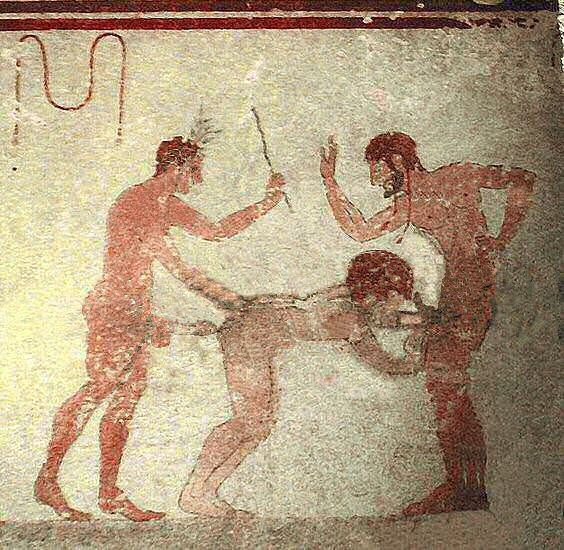
On a wall of a one-room tomb in the Necropolis of Monterozzi near Tarquinia, Italy, there’s a fresco portraying two men enthusiastically enjoying some ‘impact play’ with a naked lady. She is bent over between them, holding the hips of the man in front while delivering some ancient fellatio. He has one hand raised to deliver spanks to her lifted bottom. The other man, shown thrusting into her from behind, has one hand on her bottom while the other is raised, wielding a whip. What a grand old time!
This tomb is thought to date back to 490 BC. Its other walls depict musicians, dancers, and a nude boxer participating in the komos, a drunken procession performed by revelers in Greece. This suggests an influence of the cult of Dionysus, the god of fertility, festivity, and religious ecstasy.
The Etruscans: Ancient Masters of Salacious Celebration
The Etruscans were a wealthy and artistically sophisticated civilization in pre-Roman Italy. They celebrated life, death, and fertility with elaborate tombs, vibrant frescoes, and unashamedly erotic themes. Sexual pleasure was woven into both their spiritual and social lives. Unlike some of their contemporaries, the Etruscans embraced joy, indulgence, and sexuality as sacred elements of existence. Tombs were not viewed as grim memorials. Instead, they were immersive celebrations of the afterlife, where one could continue dancing, drinking, and SPANKING forever.
What’s especially striking about the Tomb of the Whipping’s spanko threesome is how composed the whole scene is. The arrangement of the bodies forms a perfect visual triangle—a classic Etruscan approach to balance, guiding our eye from the raised hand of the front figure down to the woman's body, then back up to the whip of the man behind her. It’s dynamic without being chaotic and erotic without being crude.
But what does it mean? Scholars have been debating the significance of this fresco since its discovery in 1960 by archaeologist Carlo Maurilio Lerici 🤌🤌🤌. The most popular theory tends to center on themes of erotic performance as expressions of magic, blessing, or communal joy. Others argue it’s simply a historical record of a particularly raucous komos celebration.
Whether this piece was meant to portray sacred sex magic or extreme Etruscan hedonism, it’s clear from the facial expressions of the three kinky participants that spanking must have been as fun for them as it is for us. They aren’t grim or aggressive; they look engaged, purposeful, and joyful. The woman’s posture is active rather than passive, braced and participating. I like to imagine the painter, brush in hand, working diligently to capture the likeness of this legendary threesome, perhaps even observing live models while perfecting the scene.
Spanking as Ritual and Magic
In this context, spanking and flogging may have had ritualistic significance. Eroticism often served as a form of magic intended to protect participants and their communities from evil influences. Sexuality wasn’t just a good luck charm—it was an affirmation of life in the face of the ever-present threat of death.
Imagine receiving a ceremonial spanking to protect your people from the dark forces of the underworld. It would not take much to convince me such a sacrifice would work. I would likely turn up to the temple each day to offer my bare bottom in benevolence. Spanking remains a life-affirming act even in these dark modern times. The glow of the cheeks surrounds my home with an aura that warms my soul through the coldest of winter days.
Because the Etruscans painted on walls that remained sealed inside tombs, their art survived far better than most others of that era. It’s worth noting that earlier examples of art depicting eroticism and corporal punishment have been discovered. Erotic papyri like the “Turin Erotic Papyrus” from ancient Egypt show explicit sex acts, though none show spanking or whipping. Egyptians did depict whipping in punishment scenes, but not in sexy ways. Many Greek vase paintings also show erotic scenes depicting BDSM-like dominance, but none with explicit spanking scenes survive the visual record.
There’s something inspiring about the fact that people in 490 BC were likely spanking cheeks as a path to divinity. Like us, they loved kink enough to capture it in their art so spankos born in the future could learn from the past and rest assured their ancestors knew what was up. To see our fetish echoed in a 2,000-year-old fresco feels like a cosmic wink from the universe. Things have changed over the centuries, but the spark behind spanking remains the same.
-T


